
Around here, we celebrate and prioritize
the well-being of LGBTQ+ and neurodivergent folks.

Get in babe, we’re heading for neuroqueer flourishing
One of my guiding principles for my life, especially in how I run my business and how I practice therapy, is to move towards neuroqueer flourishing.

I am a neuroqueer person myself, as a Queer + Highly Sensitive Person. “Neuroqueer,” coined by scholar Nick Walker, technically means being both neurodivergent and Queer, though it can also apply to anyone committed to challenging dominant neurocognitive, gender/sexuality, and other sociocultural norms.
How I interact with clients, colleagues, and everyone else is informed by the question,
“how can I create a life where I and others like me can flourish?”
My therapy fees, my hours of availability, the way I talk about my work, the contents of my clinical notes, and more are all oriented towards this.

This world was not built for people like us (Queer, trans, gay, Autistic, ADHD, traumatized, Highly Sensitive, disabled), but we are the only ones who can dream a better way forward.

Flourishing and thriving as my real self is one of the most radical things I can do.
No matter your combination of identities, I want you to be able to flourish too.
More nerdy stuff about this
-
Neurodiversity speaks to the differences within a group of brains and nervous systems, like how we use “diversity” to speak to the differences in a group of humans in terms of gender, race, ethnicity, or other factors. If you get a group of humans large enough, there will be neurodiversity present.
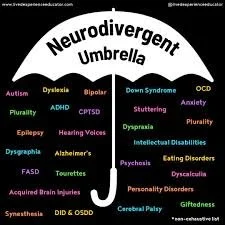
Neurodivergent means having a mind that functions in ways which differ significantly from the dominant societally constructed standards of “normal.”
Neurodivergence can be mostly or totally genetic and innate, like autism or dyslexia, or it can be mostly or totally a result of brain-altering experiences, like trauma, brain injuries, or heavy use of psychedelic drugs. Neurodivergence in and of itself is neither bad nor good.
*Credit to Kassiane Asasumasu who coined neurodivergent/neurodivergence
-
Neuronormativity is a set of norms, standards, expectations and ideals that center a particular way of functioning as the RIGHT way to function. It is the assumption that there is a CORRECT way for your nervous system (and therefore you) to exist in this world; a correct way to think, feel, communicate, play, behave, and more.
Neuronormativity presents false binaries such as: individualism vs self-abandonment, thinking vs experiencing, quantitative vs qualitative, functioning vs nonfunctioning, healthy vs unhealthy, perfect vs bad, order vs chaos, one right way vs no right ways, urgency vs laziness, comfort vs distress, logical vs illogical, holy vs sinful.
When we diverge from neuronormativity and therefore from how society expects us to function, we are labelled as having a disorder; we are seen as abnormal, unwell or having deficits.
Neuronormativity is a tool of white supremacy, colonialism, and capitalism, which have historically used the DSM to force people to conform to neuronormative standards. To be clear, diagnoses, which in my field come from the DSM, are also neither good nor bad intrinsically.
-
Neuroqueering is a verb, as can be neuroqueer. Neuroqueering is the practice of queering* (subverting, defying, disrupting, liberating oneself from) the culturally ingrained and enforced performances of neuronormativity and heteronormativity simultaneously (because they are intertwined).
Which means, by the way, even if you’re cishet and allosexual and neurotypical, you can still participate in neuroqueering your life.
Credit to Nick Walker for coining the term neuroqueer and to all the proponents of Queer theory including Eve Kosofsky Sedgwick, Judith Butler, and more. Credit also to LGBTQ AIDS activist groups, such as Act Up and Queer Nation, for reclaiming and popularizing “queer.”
-
Fluidity, flexibility, safety, reciprocity, intersectionality, openness, authenticity, expansiveness, consent, deconstruction, curiosity, creativity, and liberation
-
Nick Walker (Neuroqueer Heresies: Notes on the Neurodiversity Paradigm, Autistic Empowerment, and Postnormal Possibilities, https://neuroqueer.com/)
Robert Chapman (Empire of Normality: Neurodiversity and Capitalism)
Judy Singer (Neurodiversity: The Birth of an Idea)
Julie Tilsen (Queering Your Therapy Practice: Queer Theory, Narrative Therapy, and Imagining New Identities)
Stimpunks Foundation (Stimpunks.com)
Trauma Geek (traumageek.com)
“Neuroqueer [is]... a horizon of creative possibility with which anyone can choose to engage.”